Couple of things for photography lovers to look forward to here in Dallas.
If you're on the email list for AfterImage Gallery in the Dallas Quadrangle (proprietor Ben Breard), you know already that they're pulling some great pieces out of their amazing inventory. I'm planning a trip down there very soon.
And the Dallas Museum, which I don't usually think of as a major venue for photography, is sponsoring this spring an exciting exhibition titled "The Lens of Impressionism: Photography and Painting Along the Normandy Coast, 1850–1874". Yeah, it's an awkward title but that's the case with a lot of exhibitions. Anyway, for more info, check out the exhibit page on the Dallas Museum web site, here. Exhibit will run February 21 through May 23, 2010.
![William Porter Photography [2009-10]](https://blogger.googleusercontent.com/img/b/R29vZ2xl/AVvXsEivarWsIzJ4UBGkZm5Bhjfzd86M8FVCsnN6XYKbLreeu9ClcuVDhxQ01Et3CzACm0EEmSb8ysiGiONwchtch3c20CgUQJTV0GhZh5C0Bd-1DfUo29rk-UeOlREIxl8OTd1T3kNrMWHre3EV/s1600/GOOGLE+320x132.png)
Squeaky-clean digital, no filmy residue
Tuesday, January 19, 2010
Wednesday, December 16, 2009
A study in contrasts
I don't "make" photographs, I take them, or at least that's how I think of it. I see the photo, I shoot it. The contrasts here tickled me, so I grabbed a camera and a flash and captured the moment. (Click photo to enlarge.)

I call it "Juanita (95), Catherine (14)." Seems subtler than calling it "Old Age and Youth."
This is a rare instance of a photo that I ran through Photoshop. In the original, the blank wall on the left takes up something closer to 60% of the width of the shot, in other words, there's more white space between the nonagenarian and the teenager. I simply removed a small amount of the blank white space in order to make the two halves of the photo more nearly balanced. Does this slight editing - removal of empty space - mean that the resulting photo has been "made" and not "taken"? There's a line somewhere, that separates corrective processing from creative editing. The small change I made here might be close to that line, but I don't think it crosses it.

I call it "Juanita (95), Catherine (14)." Seems subtler than calling it "Old Age and Youth."
This is a rare instance of a photo that I ran through Photoshop. In the original, the blank wall on the left takes up something closer to 60% of the width of the shot, in other words, there's more white space between the nonagenarian and the teenager. I simply removed a small amount of the blank white space in order to make the two halves of the photo more nearly balanced. Does this slight editing - removal of empty space - mean that the resulting photo has been "made" and not "taken"? There's a line somewhere, that separates corrective processing from creative editing. The small change I made here might be close to that line, but I don't think it crosses it.
Thursday, December 10, 2009
Have you seen this kitten?
Our cats are indoor cats. The older cat, Mao, is smart enough to realize this is a good deal for her, but Kiki, the latest addition to our menagerie, has the typical adolescent's curiosity about things that aren't actually good for her, and two days ago, somehow she managed to slip out of the house, probably while I was going out to the deck where I was grilling salmon for dinner. We hunted for her that night inside and out but she ended up spending the night outdoors, and it was a cold night.
The next day, she didn't return in the morning, so I made a flyer to distribute in the neighborhood. I have a number of photos of her, but I picked a photo of her and Catherine. It's a satisfactory photo as a description of Kiki: You can see that she's a black kitten with white on her face and chest. But I chose this photo especially because it has Catherine in it. Most lost animal flyers show only the animal. I thought it would get people's attention to show them that this kitten is dearly loved and missed by a young girl.

I'm happy to report that, late in the second day - twenty-four hours exactly after her disappearance - Kiki responded to Catherine's calls from the back porch, crawled out from under our house where apparently she had spent the night, and let Catherine pick her up and bring her back in. She had no doubt heard me calling her over and over, but she ignored me and responded to Catherine. Well, I'm very relieved to have her back home.
The next day, she didn't return in the morning, so I made a flyer to distribute in the neighborhood. I have a number of photos of her, but I picked a photo of her and Catherine. It's a satisfactory photo as a description of Kiki: You can see that she's a black kitten with white on her face and chest. But I chose this photo especially because it has Catherine in it. Most lost animal flyers show only the animal. I thought it would get people's attention to show them that this kitten is dearly loved and missed by a young girl.

Friday, December 4, 2009
The blog's new web address
I finally got around to tying this blog more closely to my domain. You can now get here using this address:
http://blog.william-porter.net
You might want to update your bookmark!
http://blog.william-porter.net
You might want to update your bookmark!

Thursday, December 3, 2009
Body Double
When I shoot, even casually, I often carry more than one camera body. When I'm working, I always carry more than one body.
This is a pretty old practice, especially for news and sports photographers, going back at least to the early days of the single-lens reflex camera. If you can find old news or sports photos that include photographers in them, you'll see this. For example, in Hans-Michael Koetzle's terrific book, Photo Icons, volume 2, there's a photo by a great German news photographer Barbara Klemm, showing Leonid Brezhnev (Soviet Communist Party Chair at the time) meeting German Chancellor Willy Brandt in Bonn. The photo mainly shows the principals and their translators and advisors huddled together to negotiate. But in the near background, there's another photographer, shooting the back of Brezhnev's head. He's holding one Nikon with what appears to be a wide lens, and he has two other Nikons hanging around his neck, one of which has a telephoto lens.
I found Klemm's image on the Web. (Google Images never ceases to amaze.) Notice the photographer in the back on the left.

Anyway, carrying two or more bodies is still common, or at least not uncommon. I routinely carry two cameras with me, and sometimes three. This was true when I was working an event in the past, where I'd carry a wide, fast zoom on one camera and a tele, fast mid-range or longer-range zoom on the other. Now that I work mostly with primes, I carry more than one camera even more than I used to, because I would prefer not to change lenses. For example, I might carry the K10D with a Sigma 28 f/1.8 and the K20D with (perhaps) the Pentax 70 f/2.4. This gives me a choice of focal lengths, which is exactly what the old news photographers wanted when they carried more than one body.
Carrying more than one body also means that I'm less likely to be stopped cold by equipment failure. If one camera were to fail - and it has happened - I have the other camera right there, in my hand or at least around my neck, turned on and working. I can't apologize to the couple and the minister and ask them to pause the wedding ceremony for one minute while I get the backup out of my bag!
(This post is a revised version of a reply that originally appeared in the pentaxforums.com discussion site.)
This is a pretty old practice, especially for news and sports photographers, going back at least to the early days of the single-lens reflex camera. If you can find old news or sports photos that include photographers in them, you'll see this. For example, in Hans-Michael Koetzle's terrific book, Photo Icons, volume 2, there's a photo by a great German news photographer Barbara Klemm, showing Leonid Brezhnev (Soviet Communist Party Chair at the time) meeting German Chancellor Willy Brandt in Bonn. The photo mainly shows the principals and their translators and advisors huddled together to negotiate. But in the near background, there's another photographer, shooting the back of Brezhnev's head. He's holding one Nikon with what appears to be a wide lens, and he has two other Nikons hanging around his neck, one of which has a telephoto lens.
I found Klemm's image on the Web. (Google Images never ceases to amaze.) Notice the photographer in the back on the left.
Anyway, carrying two or more bodies is still common, or at least not uncommon. I routinely carry two cameras with me, and sometimes three. This was true when I was working an event in the past, where I'd carry a wide, fast zoom on one camera and a tele, fast mid-range or longer-range zoom on the other. Now that I work mostly with primes, I carry more than one camera even more than I used to, because I would prefer not to change lenses. For example, I might carry the K10D with a Sigma 28 f/1.8 and the K20D with (perhaps) the Pentax 70 f/2.4. This gives me a choice of focal lengths, which is exactly what the old news photographers wanted when they carried more than one body.
Carrying more than one body also means that I'm less likely to be stopped cold by equipment failure. If one camera were to fail - and it has happened - I have the other camera right there, in my hand or at least around my neck, turned on and working. I can't apologize to the couple and the minister and ask them to pause the wedding ceremony for one minute while I get the backup out of my bag!
(This post is a revised version of a reply that originally appeared in the pentaxforums.com discussion site.)
Tuesday, November 10, 2009
Crop rotation
Some of the great photographers of the past didn't believe in cropping. I'm pretty sure Cartier-Bresson framed his pictures in the camera's viewfinder and that was the end of that. A lot of photographers today don't believe in cropping. At least, I'm sure that 90% or more of the photos that get posted on personal photo-sharing sites have never been cropped.
On a purely practical level, anybody who sells prints to clients as I do, has to accept the fact that clients have their own ideas about print and frame sizes. The sensors in all of my Pentax cameras have an aspect ratio of 2/3, that is, the short side of the sensor and thus of the resulting image is 2/3 as long as the long side. If I put the photo online with its original aspect ratio, it will print nicely at (say) 4" x 6" or 8" x 12". Unfortunately, a client might want a 5" x 7" print because that's the size frame she's got to fill. If I filled my viewfinder perfectly when I composed the shot, cropping to 5" x 7" might require doing violence to the image, like chopping off the top of somebody's head. When I'm shooting for clients, I make an effort to capture a little more than I think ideal to frame the photo, precisely to provide cropping room to accommodate different aspect ratios.
On the other hand, most images do have a "right" aspect ratio. At least I think that's the case. And unfortunately it's not always 2/3. Especially when I'm shooting for myself, I will crop the picture in post-processing in the way that seems right to me. For a shot of the Grand Canyon, that might mean an aspect ratio of 1/3 or even wider. Occasionally, 1x1 seems right. But the right aspect ratio isn't always obvious, even after I review the photo on my computer.
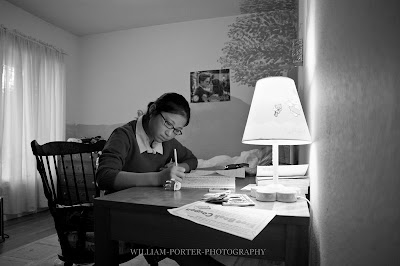
I rather like the photo just the way I took it. But as I was making the black and white conversion in Adobe Lightroom 3 beta, I began to wonder if all that blank wall on the right side of the photo was good. Or rather, I began to suspect that it was accidental, just wasted space that was there because of my vantage point. So I cropped it out:
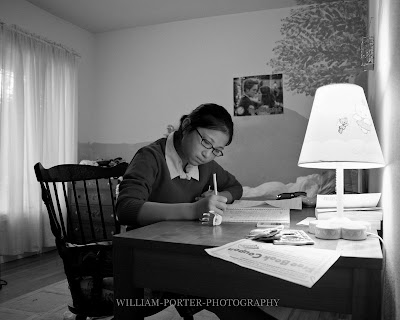
That's okay, I said to myself, but for some reason it seems rather boring now, a mere snapshot, when the scene that I was pretty sure I saw had struck me as more interesting. You see, once you actually look at the photo, it's often hard to remember what you were thinking of when you took it. Actually, I quite frequently ask myself, "What the hell was I thinking of when I took this photo?"
Anyway, at this point, I was starting to guess. And I guessed that the problem now was that there was too much of the ceiling in the upper background. So I cropped that out too:
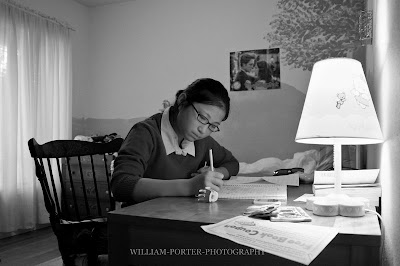
But that was clearly going in the wrong direction. So I went back to the original photo and thought about it for a few seconds more. And a lightbult went off in my head. The blank wall on the right was important to the photo, because it very nicely balances the wall and the curtained window on the left. But there was extraneous stuff above and below the interesting horizontal center area of the photo. So I changed my crop ratio to 1/3, et voila!
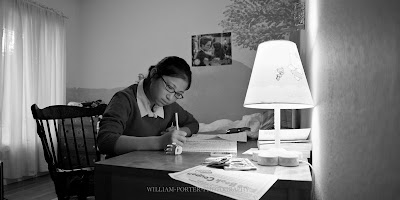
That is the picture I saw initially, the picture I meant to take. At least, I think so. It's better than the previous two crops. I think it's an improvement over the original photo, too, but I'm less sure of that. Unfortunately, it's going to be a pain to print and frame!
To crop, or not to crop?
It's not an easy matter to decide.On a purely practical level, anybody who sells prints to clients as I do, has to accept the fact that clients have their own ideas about print and frame sizes. The sensors in all of my Pentax cameras have an aspect ratio of 2/3, that is, the short side of the sensor and thus of the resulting image is 2/3 as long as the long side. If I put the photo online with its original aspect ratio, it will print nicely at (say) 4" x 6" or 8" x 12". Unfortunately, a client might want a 5" x 7" print because that's the size frame she's got to fill. If I filled my viewfinder perfectly when I composed the shot, cropping to 5" x 7" might require doing violence to the image, like chopping off the top of somebody's head. When I'm shooting for clients, I make an effort to capture a little more than I think ideal to frame the photo, precisely to provide cropping room to accommodate different aspect ratios.
On the other hand, most images do have a "right" aspect ratio. At least I think that's the case. And unfortunately it's not always 2/3. Especially when I'm shooting for myself, I will crop the picture in post-processing in the way that seems right to me. For a shot of the Grand Canyon, that might mean an aspect ratio of 1/3 or even wider. Occasionally, 1x1 seems right. But the right aspect ratio isn't always obvious, even after I review the photo on my computer.

Catherine studying
Walking down the hall this afternoon, I peeked into Catherine's room and saw her studying, and I could see at a glance that it would make an interesting photo. So I grabbed the camera, came back, and as politely and unobtrusively as possible, I squatted down and took two quick shots. The shot above is what the camera saw, at its native aspect ratio of 2/3.I rather like the photo just the way I took it. But as I was making the black and white conversion in Adobe Lightroom 3 beta, I began to wonder if all that blank wall on the right side of the photo was good. Or rather, I began to suspect that it was accidental, just wasted space that was there because of my vantage point. So I cropped it out:

That's okay, I said to myself, but for some reason it seems rather boring now, a mere snapshot, when the scene that I was pretty sure I saw had struck me as more interesting. You see, once you actually look at the photo, it's often hard to remember what you were thinking of when you took it. Actually, I quite frequently ask myself, "What the hell was I thinking of when I took this photo?"
Anyway, at this point, I was starting to guess. And I guessed that the problem now was that there was too much of the ceiling in the upper background. So I cropped that out too:

But that was clearly going in the wrong direction. So I went back to the original photo and thought about it for a few seconds more. And a lightbult went off in my head. The blank wall on the right was important to the photo, because it very nicely balances the wall and the curtained window on the left. But there was extraneous stuff above and below the interesting horizontal center area of the photo. So I changed my crop ratio to 1/3, et voila!

That is the picture I saw initially, the picture I meant to take. At least, I think so. It's better than the previous two crops. I think it's an improvement over the original photo, too, but I'm less sure of that. Unfortunately, it's going to be a pain to print and frame!
The right crop for every photo
I do believe that there is a "right" aspect ratio for every photo, and it's not always 2/3. But if the picture needs cropping, the right crop isn't necessarily a nice clean ratio of even numbers like 2/3, 4/6 or 5/7. Still, I stick to the simple ratios, because they print the best. It's part of the compositional challenge.Monday, November 2, 2009
Orb weaver
I'm not a macro photographer. I don't know anything about flowers or insects, and while I love flowers, most insects give me the creeps. But after mentioning Thomas Shahan the other day, when a spider built a big web in our front yard stretching between a bush and the small burr oak tree, I couldn't resist and I grabbed the camera.

My first shots weren't too satisfying. Today the spider was still there, so I took another stab at it, this time, with the help of artificial lighting.
Proof once again that light is more important than almost everything. Want to take better photos? Look for better light. And then think about better lenses. The last thing to worry about is your camera.
Subscribe to:
Posts (Atom)