Thursday, July 15, 2010

Traveling light: The post-mortem

Well, I'm back from my excellent vacation adventure, mostly but not exclusively in Yellowstone National Park. A couple of weeks ago, I wrote a post titled "Traveling Light," in which I revealed that I had—with some hesitancy—decided to leave my Pentax DSLR bodies and my excellent lenses at home, and instead to entrust my vacation photos completely to a couple of relatively inexpensive compact, fixed-lens cameras.

And that's what I did. My pro gear stayed home and the compact cameras traveled. Now that I've had a chance to review the photos, select my favorites and post them online, what do I think about this experiment? Was it a success or a failure?


Wildlife: Panasonic FZ35

We saw lots of wildlife on this trip, mostly in Yellowstone, but also in Custer State Park in South Dakota and elsewhere. We saw grizzly bears (but no black bears, I think), gray wolves, lots of bison, coyotes, elk, white-tailed deer, pronghorns, marmots, otters, not to mention lots of birds, including an osprey, a couple of bald eagles, a couple of sandhill cranes, what was probably a downy woodpecker, and a very colorful bird that we think was a western tanager. I'm justing rattling off the species I can remember easily.

I'm fairly satisfied with the pics I got with the FZ35, in most cases. This pic of a buffalo lying in the grass was taken in the middle of the FZ35's zoom range (around 200mm equivalent), which is usually a "sweet spot" for lenses:


There's a fair bit of detail here, acceptable noise (the shot was taken at ISO 80, the lowest setting), and good color. I'm confident it will print well.

This shot of the engineers building in Mammoth Hot Springs is slightly less satisfactory:


Fortunately I captured this as a raw file. The unprocessed original is somewhat "soft", but I think the final result turned out okay, after I boosted the blacks, the contrast and especially the "clarity" in Lightroom 3. Still, I can't shake the feeling that this shot would have been sharper if I'd taken it with my Pentax K20D and, oh, the Pentax 70mm prime.

The FZ35 shined when I was able to get fairly close to my subject, and when the light was good. We were not more than 25ft from these otters as they played near the banks of Trout Lake in Yellowstone:


I'm happy with that shot and don't think it would have been better if I'd had better equipment. There was a serious photographer there at the same time, shooting with a film SLR. Apparently he's quite devoted to the otters. I'd like to see some of his photos. But I'm happy enough with this.

The grizzly bears and wolves were far less cooperative than the otters. This shot of a mother grizzly with her three cubs was taken in the early morning, at Alum Creek in the Hayden Valley. I was using the FZ35 with the 1.7x teleconverter attached, and with the camera mounted on a tripod for additional stability. The FZ35's in-camera image stabilization is actually quite good, but when you are shooting at an effective focal length of over 800mm, well, image stabilization can only do so much.


This grizzly was probably a quarter mile away from us at the time. I tried to remember, when attaching the converter, to switch into the FZ35's shutter priority mode so I could keep the shutter speed over 1/500th sec. This wasn't quite as fast as the old rule of thumb requires (that would be 1/800th sec) but I let the camera's image stabilization do some work and I think the results were okay. At this distance, the limitations of the resolution of the lens become apparent. Teleconverters get you a longer reach but you pay for it in light lost (about a stop) and image clarity. But getting closer wasn't an option; we were restrained by the ranger, and if the ranger hadn't been there, I would have been restrained by my wife; and if my wife hadn't been there, I would have had to rely on my own disinclination to risk being mauled by a grizzly. So this is the shot I got.

Could I have gotten this shot with my DSLR gear? I doubt it but I'm not sure. If I shot with my K20D and the Tamron 70-300 ED Di Macro, and if I was using the Tamron 1.4x teleconverter as well, I'd have an effective focal length available of something over 600mm. Now the difference between 600mm and 800mm in this situation is less than you might think. It's possible that the DSLR's much better performance at higher ISOs would become a factor here. The shot above was taken at ISO 200, which on the FZ35 is a fairly noisy sensitivity level. If I had shot this at ISO 400 or even 800 on my K20D, I am pretty sure it would be less noisy and more fine detail would have been preserved. The field of view would have been narrower (that is, the bears would have seemed "smaller" in the frame) but the greater resolution of the DSLR might have permitted me to crop and get something close to what I got with the FZ35. I just don't know. What I am pretty sure of, however, is that what I could have gotten with my DSLR gear would not have been better.

(I hasten to emphasize that I'm comparing the FZ35's performance and capabilities with my personal DSLR lens options, not with what a pro photographer could do with a $6000 lens.)

The noisiness of the FZ35 at anything over ISO 100 became an even more serious problem when, on another day, we spent a long time one afternoon watching these bears chew on a bison carcass on the bank of Soda Butte Creek, in the Lamar Valley.


We were a fair bit closer to the bears this time—not more than a couple of hundred yards, I think, if that—but it was a drizzly overcast afternoon, in other words, the light sucked. In order to keep the shutter fast, I had no choice but to boost the ISO to 400, and that meant losing detail. The other problem here was that I wasn't using the tripod. Instead, for some reason, I grabbed the monopod instead.

But I think the images are quite satisfactory, as vacation photos. I got a gray wolf, too. She (the ranger told us it was a female) was hanging around in the neighborhood, probably hoping to get to the carcass if the bears abandoned it. Didn't happen.


I'm glad I had that reach.

The bottom line is that the FZ35 basically performed as well as I expected it to, which was pretty well.  These photos aren't going to end up in National Geographic, but I'll be happy making prints of them for a vacation album.

I should add a note about the Panasonic 1.7x conversion lens. Dealing with it—putting it on and taking it off—involves a certain amount of hassle, akin to the hassle involved in changing lenses on a DSLR. Except that at no time do the camera's innards get exposed to the air and its hazards (dust, pollen, moisture, etc.).

Landscapes and people: Panasonic LX3

Going into the vacation, I knew that, within its limited zoom range, the LX3 was a superior camera, indeed, within its limited zoom range and its even more limited range of satisfactory sensitivity (ISO 80-100), the LX3 is a very good camera, compared to just about anything. That Leica f/2.0-2.8 24-60mm (effective) lens is a real winner. And I understand that the LX3 has a slightly larger sensor than the FZ35. Anyway, from a technical perspective, the best shots I took on this vacation were taken with the LX3.

I was a little vague even at the time about which of the falls this was. I think this is a shot of the Lower Falls, as seen from above.


I did the black and white conversion in Adobe Lightroom 3. But the raw file from the LX3 gave me everything I needed to work with to make a decent conversion. I used the LX3's 16:9 aspect ratio a lot, and usually cropped those photos to my personal favorite 2:1 aspect ratio for web display and printing.

I had a neutral density filter for the LX3 and tried it when shooting a couple of other falls. I didn't use it here because I did not want to blur the water. I really like the sharp definition in the water at the top of the falls.

This shot of my wife and daughter along the path down from Trout Lake is very different from the waterfall shot:


The LX3 gave me the wide-angle I needed here and the fast aperture; this shot was taken at f/2.4 and ISO 100. Color rendition is good and the shot is nicely detailed.

But my favorite use for the LX3 is landscapes. Here is one of my favorites:


These last two were taken not in Yellowstone but in Rocky Mountain National Park, where we camped for two nights on our way north from Dallas. This is the Moraine after a rain (and hail) storm.


The image's vibrance was goosed a little in Lightroom 3, but those colors are basically the colors that I saw.

The last picture is perhaps my favorite of the vacation and it illustrates the LX3's adaptability. I had to make a midnight run to the comfort station one night at Rocky. While I was out of the tent, I noticed that the Moraine—which our campground looked down upon from the north—was full of fog and the moon was shining above it. Everybody else in the campground was sound asleep, so as quietly as I could, I hauled the tripod out of the van, put the LX3 into manual mode, took a couple test exposures, and then captured this:


You can click that image for a larger version. Yes, it's a tad noisy, but hey, this is a six second exposure on a compact camera! I shot at ISO 400. In retrospect I wish I'd shot at ISO 200 and done a 12 second exposure. Nevertheless, I'm pretty happy with this shot. The Moraine at Rocky Mountain National Park, like the Eiffel Tower and Mount Rushmore, has been photographed millions of times and most of the photos look like all the others. It's nice to have a chance to take a shot that looks a bit different.


Conclusion


My conclusion is that the experiment was generally a success.

One of my main motives for leaving the DSLR gear at home was that I didn't want to have to lug a variety of lenses around. That worked out well. Even though I was carrying two cameras with me in the car most of the time, both were small. And although I did have to fiddle with the FZ35's teleconversion lens occasionally, in general, I was able to grab a camera and go to shoot.

The other main goal was to take photos that were not worse than those I'd have taken with my DSLR kit. That's not a high standard, of course, but it was a realistic one. And I'd say that standard was fairly well met.

Our next family vacation takes us to another national park, Big Bend, in southwest Texas. I could change my mind in the next few months but right now I expect I'll be carrying the same two cameras I took with me to Yellowstone.

Tuesday, July 13, 2010

Don't Say Cheese

I'm experimenting with a number of changes here. I've fiddled with the look over the last couple of months. Blogger gives me more control than I'm taking advantage of, but I like to keep things clean, and I also want to keep things simple for myself.

And now I'm playing with a new name: "Don't say cheese." I don't tell my subjects to say cheese. I don't even ask them to smile. Instead, I try to get them to smile without being asked. It gives better results.

And I try not to take cheesy photos, which in itself makes me something of a stand-out in the wedding photography biz.

On the downside: If you didn't know that it was the title of a photography blog, would "Don't say cheese" make you think of photography? Maybe, but I doubt it. Without a context, it sounds more like advice you would give to someone who was taking a quiz about French food.

So enjoy the new name while it lasts. Maybe it will stick. Maybe it won't.

Thursday, June 24, 2010

If you have the FZ35, do you really need a 1.7x teleconverter, too?

As I mentioned in yesterday's post, the Panasonic FZ35 has a 18x zoom range that extends from 27mm to 486mm in conventional 35mm film or 36x24 digital ("full frame") terms. That's some serious zoom action.

So, if you can reach 486mm (effective) with the FZ35 on its own, do you really need the 1.7x teleconverter? After all, you can always just shoot at full zoom and crop, to make the subject appear bigger in the frame.

Well, the short answer is that the teleconverter is indeed useful.

Here is a photo of a car across the street. This was taken at full zoom extension (486mm equivalent) and cropped. What you are seeing here is actually a screen shot from Adobe Lightroom 3.


Now here is essentially the same shot, taken with the Panasonic DMW-LT55 1.7x teleconverter attached.


As you can see, the field of view is about the same in the two photos, that is, the car is about the same size in each photo. And the two images look just about identical in other ways, at least at this size. So are they in fact identical? Is the one taken without the teleconverter as good as the one take with the teleconverter?

No, it's not.

The one taken with the teleconverter actually has more pixels, more data. This means several good things. It will be possible to print the second shot somewhat larger than the first. The second shot will be more amenable to certain post-processing maneuvers, such as noise reduction and sharpening, because there is more data to work with.

Here's an enlargement of the license plate from the first shot (the one taken without the teleconverter). The enlargement ratio here is 3:1.


And here is an enlargement from the second photo (the one taken with the help of the teleconverter). The enlargement ratio here is only 2:1. In other words, I didn't have to work the pixels as hard this time to get the same size on screen.


The difference doesn't seem dramatic at first glance, but look again. Look at the Nissan badge above the plate, or the State of Texas symbol in the middle of the plate, or the word "MAXIMA" at the bottom. In the second image, everything is a little sharper, a little smoother and less pixelated.

*

Here they are again, a little smaller. I'm simulating the effect of printing here. You should be able to see that the second image is sharper and simply "better" than the first one. If you can't see the difference, well, you might be running into the limitations imposed by your computer's display.


*

The bottom line here is, the 1.7x teleconverter is actually useful. Say I have the good fortune not only to see a wolf in Yellowstone but actually to be able to set up my tripod and take a photo of one. From what I've read, it's almost certain that the wolf is going to be a long way in the distance. I can take the shot with or without the teleconverter. But if I use the teleconverter, I'll collect more data. The image of the wolf will be comprised of more pixels, which means the wolf will be higher resolution. And that's good.

A final point. There's a practical limit to the advantage of the teleconverter, and I'm working very close to that limit. The limit is set by two things: the quality (acuity or sharpness) of the lens; and the effective focal length at which you are working when the teleconverter is attached.

The quality of the lens that channels light to the camera's sensor determines how efficiently and effectively the available pixels are used. The number of pixels captured isn't the only thing that matters, in fact, it's not even the most important thing. A really good lens on a 10 megapixel camera will produce better photos than a mediocre lens on a 14 megapixel camera. Returning to the FZ35 and the teleconverter, the FZ35's built-in Leica lens is rather good, and the Panasonic teleconverter is not bad. But at full zoom extension, the FZ35 plus teleconverter seems to have reached its maximum resolving power, that is, more pixels in the sensor wouldn't matter because the lens is already starting to lose detail. A lens is an analog device, of course, it doesn't have pixels. But you can't just keep giving the lens more and more pixels and expect the lens to record finer and finer detail.

The other practical limit here is imposed by the focal length. With the 1.7x teleconverter attached, the FZ35, at full zoom extension, is shooting at a focal length equivalent to 826mm. Most serious photographers never own a lens with an effective focal length greater than 500mm, and many never even reach that. Now, when you are shooting at 500mm, 600mm, 800mm, even the tiniest vibration or instability in the camera can affect the sharpness of the image that is captured. The photos above were not taken with the camera on a tripod; I simply used a monopod. If I do use the teleconverter in Yellowstone, I will have the camera on a tripod, and I will use a 2 second shutter delay so I can get my hands off the camera before the picture is actually taken. At this extreme focal length, the merest touch can wreck a photo.

Nevertheless, while the teleconverter is pushing the FZ35 to its extreme limits, it's not exceeding those limits and if you really need extra telephoto reach, it's better to have the 1.7x lens than to do without and simply crop. Q.E.D.

Wednesday, June 23, 2010

Traveling light

Well, we're off on vacation pretty soon. Most of our time will be spent at Yellowstone National Park. I've never been. Everybody says it's a photographer's paradise, because it's beautiful everywhere you look, and because it has just about everything you could ask for in the way of natural beauty: mountains, prairies, geysers, waterfalls, rivers, lakes, ponds, forests, not to mention wildlife in the form of bears (two kinds), wolves, wolverines, badgers, beavers, bison, coyotes, eagles, osprey, hawks, falcons, ravens, bluebirds, and on and on. I've been doing my homework, reading both of the excellent books about photography at Yellowstone that I could find at Amazon (Lange's, and Verderber's), and getting advice from other photographers, mostly online, about where to go and what to look for. You gotta do your homework!

Well, with all this great stuff waiting for me to point a camera at it, you might think that I'd be bringing my best camera and best lenses. But you'd be wrong.

I've taken my Pentax gear with me to Rocky Mountain National Park, to the Grand Canyon, to Big Bend, to Aransas National Wildlife Refuge, and elsewhere. And yes, it does a terrific job. If somebody were paying me to go to Yellowstone and take photos, I guess I'd take my Pentax gear.

But I've decided this time to go light. I'm leaving the DSLRs and all the lenses at home, and I'm taking just a couple of Panasonic fixed-lens cameras. I hasten to add, a couple of very good fixed-lens cameras.


For landscapes


For landscapes, I'll rely on the old Panasonic LX3, which still seems to me the very best digital compact camera ever. With its outstanding ultra-wide (24mm equivalent) Leica lens, it's a perfect camera for landscapes, like this shot of the spillway at White Rock Lake in Dallas:


The LX3 is terrific for macro (close-up) photography, as well.


I have a circular polarizing filter (for shooting the geysers) and a neutral density filter (possibly for shooting waterfalls) for use with the LX3, so I think I'm in good shape.

In the past, if I was shooting a landscape with a Pentax DSLR, I have relied mainly on the Sigma 10-20 ultrawide zoom, an outstanding lens. It's the only lens I took with me to the bottom of the Grand Canyon last Christmas. In 35mm equivalence, its range is 15mm to 30mm, so it gives me a considerably wider angle of view than the LX3's 24mm. But the LX3 has twice the reach at the other end (it goes to 60mm). In short, the LX3 is right in the range where I take most of my photographs. If it were a bit better in low light, I could shoot a wedding with the LX3, something I would never try with the Sigma 10-20! If I weren't going to use the LX3 at Yellowstone, I'd have to take the Sigma 10-20 AND at least one, probably two of my prime lenses, perhaps the Sigma 28 and the Sigma 40. More likely, for Yellowstone (since it's not the Grand Canyon), I'd leave the 10-20 at home and take the Pentax 21 and the Pentax 40. Those are both small lenses. Still, that would be three to four times heavier than the LX3 and bulkier by about the same factor.

But if I had a Pentax DSLR body and the 21 and 40mm primes, I would still lack a couple of things the LX3 offers: outstanding macro capability, and the ability to shoot high-def video!


For wildlife


The harder, much harder, part of the problem is what to take to shoot wildlife. I'm a portrait photographer, a wedding photographer, and the fine lenses that I have are all in the wide to normal to weak telephoto range. My only long lens is a Tamron 70-300, which is a decent consumer lens, but, well, not in the league of the stuff I take to a wedding.

The reason I have the Tamron 70-300 is that it's very affordable. Really high-quality telephoto lenses like the Pentax DA* 300 or the Sigma 150-500 ("Bigma") are not.

At first, I thought I'd just stick with what I had already, the LX3, and, well, just look at the wildlife through binoculars. But I decided that was crazy. But I didn't want to bring a DSLR and the 70-300, either. If I am going to go light, I'm going to go light.

So I decided to get a second compact camera with a good telephoto zoom.

I first tried the Pentax X90. I don't really want to talk about it. Pentax's DSLRs are terrific, really top notch. Its compact cameras, alas, not so much.

After a little more research, it became clear that Panasonic has ruled the compact camera category, or at least been a major competitor and innovator in that field, for years. So I tried the Panasonic Lumix DMC-ZS7. The image quality was pretty good, and the zoom had a pretty good reach, too (300mm equivalent). Here's a pic of a coot:


The detail in the coot's feathers is actually better than it looks in this web-ready image. The ZS7 is compact and has GPS built-in, although I probably would not use the GPS feature in Yellowstone because we'll be camping and I'm going to be worried about battery use. The ZS7 seems like a really nice camera for a lot of photographers, and I've seen some wonderful photos taken with it. But for me, it had a couple serious weaknesses. First, it doesn't support raw capture. (The LX3 does, by the way.) I am not yet sure whether I'll shoot raw in Yellowstone or not but I want to have the option. Second, the ZS7's 300mm (equivalent) reach is just not going to be long enough to photograph a wolf or a baby bison. A final problem with the ZS7, for me personally anyway, is that, as far as I can tell, it doesn't support add-ons in any way. Mainly that means that I can't use it with filters.

So the ZS7 went back, too. And now I have a Panasonic Lumix DMC-FZ35, which is what I'll be taking with me to Yellowstone. Its zoom range is from 27mm to an awesome 486mm (equivalent). With the Panasonic LT55 telephoto conversion lens attached, the FZ35 can actually reach over 800mm (equivalent)! And did I mention that it cost $300—a small fraction of what I'd have to spend to get a better, longer lens for my Pentax DSLR body.

Unlike the Pentax X90, the Panasonic FZ35 produces photos that I think are really pretty good. And unlike the Panasonic ZS7, the FZ35 also supports raw capture, and it accepts filters. Folks, we have a winner. Well, it's not as compact as the ZS7. But it is very light.


Zoom zoom


How good is the FZ35's zoom? Well, consider this. Here's a shot I took from the east side of White Rock Lake (near my house in Dallas). I'm looking west across the lake toward the old pump house.


Interesting side note: The blur on the left side of the photo was caused by an insect on the lens. You have to keep your lenses clean, even if you have a compact camera!

Now the previous photo is a bit deceptive. The wide-angle view makes even the biker seem farther away than he is. He's probably about 35-40 ft away. But as you can see, the pump house is a long way away. I just tried to calculate the distance using Google Maps, and it's about half a mile across the lake at this point. Imagine that there was a wolf or a baby bison standing on the porch of the pump house. I'd be out of luck, right?

Maybe not. Here's a photo of the pump house taken with the FZ35's zoom extended all the way (486mm equivalent).


And here's a shot with the 1.7x teleconverter attached.


OK, if there were a wolf, say, lying on its side on the porch of the pump house, I'm not saying I'd be able to tell if it was a boy or a girl. But I'm pretty sure I could tell it was a wolf and not a coyote, which is a good start.

Of course, test shots of far-away buildings aren't really very indicative of how the lens will perform if I'm shooting wildlife. Perhaps this is a better example of the FZ35's zoom range. This was taken from the same spot as the previous pic, and the rowers were in the middle of the lake.


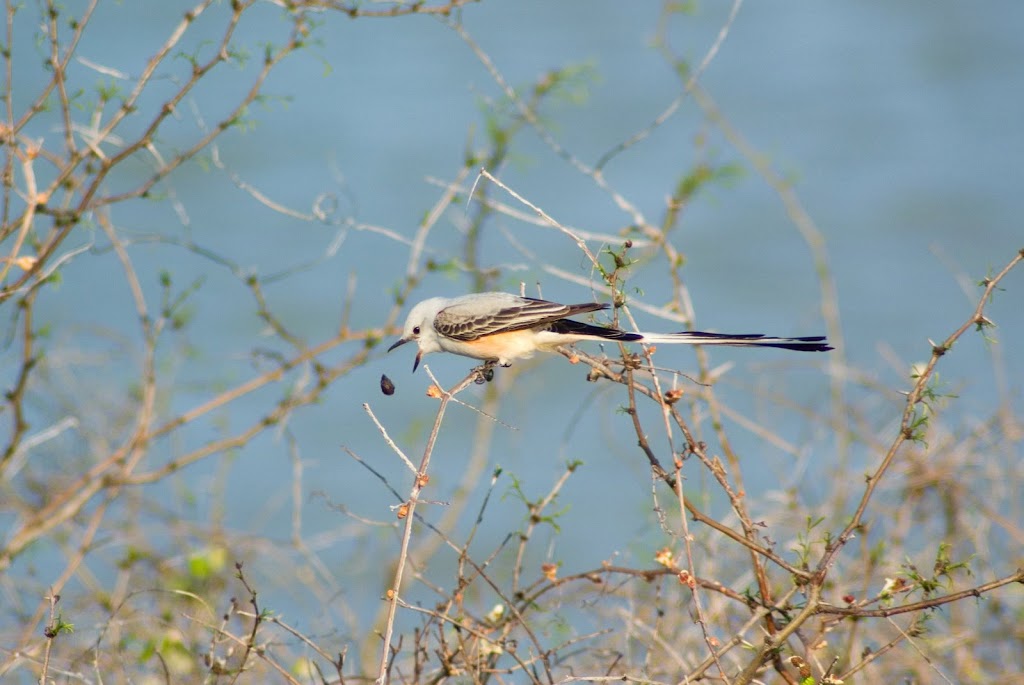
And here's an uncropped shot of a scissor-tailed flycatcher that was zipping around where I was taking these other photos.


Compare that to this cropped photo of a scissor-tail that I took down in the Aransas National Wildlife Refuge a few years ago:


That was taken with the Tamron 70-300.


Proof is in the prints


So is this a good idea—leaving the really good cameras and lenses at home, and taking a couple of inexpensive "point and shoot" cameras? I think so, but to be honest, I won't really know until I get back and get some images printed. A big weakness of image comparisons on the Internet is that they're limited by the display medium, your monitor. Sometimes you can't really tell how much better one image is than another until you send both to a high-quality printer. I'll back to you at the end of the summer when we're back and I've had a chance to print and review my photos.

And if it does turn out to be a bad idea, I'll just have to go back to Yellowstone and try again.

Redesign underway

I'm in the process of redesigning everything—my web site, my galleries, and this blog. Rather harder than you might think. For one thing, the web site is designed by moi and coded by moi. (Tip: Don't hire a photographer because you think their web site is cool. There's a better than even chance they bought the template for the web site.) Anyway, I code the web site, but the galleries are hosted at zenfolio.com, and the blog is hosted by Blogger (a Google service). Getting all three to have a consistent look is almost impossible. Very frustrating. Anyway, it's not going to get done now until we get back from vacation in mid-July.

Wednesday, June 16, 2010

Perspective correction in Lightroom 3!

Sometimes my prayers are answered. I've been using the Lightroom 3 beta for months, but Lightroom 3 was just officially released, and I was overjoyed to discover that it includes perspective correction tools that weren't there in the beta.

What's perspective correction? Well, here's a photo I took today in downtown Dallas, on the east side.


And here's the same photo, after a little perspective correction on the vertical axis.


Makes a big difference, no?

Here's the photo I was really after. Click to view it full size:


This panorama was actually created in Photoshop Elements 8, and then given final processing in Lightroom 3; so the perspectival correction in the pano was done in Photoshop. But it's nice to know I can now fix single images in Lightroom 3 when I need to.

Tuesday, June 15, 2010

Panasonic LX3: How wide is wide?

Yesterday I took a couple pictures at the lake, using the unassisted LX3 at its widest angle (= 24mm in full-frame terms), and then using the Panasonic DMW-LW46 Wide Conversion Lens. Unfortunately, the scene I was photographing didn't have enough distinguishing features in it to show the difference in angles of view clearly. So today I tried again, this time shooting the back of my house.


Here's a shot of our garage, with the LX3 zoomed in as tight as it can go (= 60mm in full-frame terms). Note that in this shot and in the two that follow, I'm standing about 30 ft away from the near corner of the garage.


In full-frame terms, 60mm is a weak telephoto; the "normal" angle of view is around 50mm.

The following shot was taken with the LX3 zoomed out to its widest angle of view (= 24mm in full-frame terms).


And finally, here's the same scene captured using the LW46 Conversion Lens, which takes the LX3 to an effective ultra-wide angle of view of 18mm.


Is the LW46 worth its small price? I certainly think so.

*

Postscript a week later (6-19-2010): Notwithstanding the enthusiasm I felt for it when I was writing about it above, I decided to return the LW46 wide-angle conversion lens. The lens itself really is quite good and I would not discourage anybody from getting it. However, what I decided for myself was that the lens kind of defeated the point of the LX3, which is to have a small camera with some flexibility. With the conversion lens mounted, the LX3 is no longer pocketable. And once the conversion lens is attached, you can't zoom; you're only able to shoot at the effective 18mm focal length. I've decided that, when I need to go wider than 24mm (effective), I can just take two or three shots and stitch them together. See my next post.